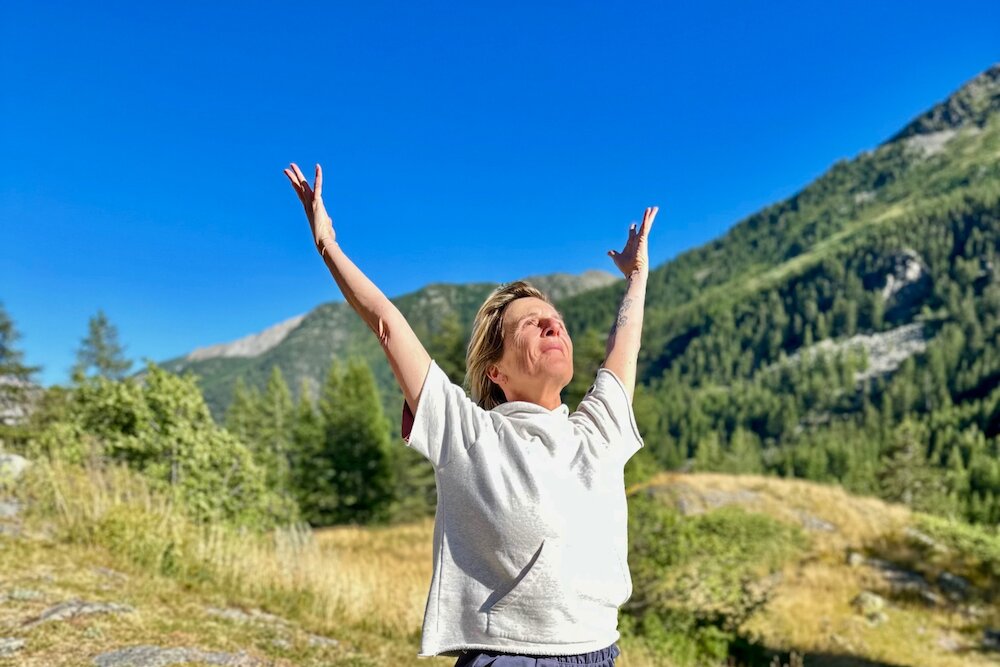
I’m moving. I’m leaving the apartment where I’ve lived for nearly 25 years. I’ve come across some old notebooks, covered with notes and little drawings, kept over the years and almost forgotten at the back of a shelf. These notebooks contain my yoga notes, taken during training courses and workshops in France and abroad 15, 20, and 25 years ago. These notebooks reveal my age and how long I’ve been teaching yoga. That was before Instagram and before websites specializing in yoga. Written notes were essential for remembering the information I’d heard; drawing the poses and their variations was the only way to remember them.
What is my place today in a yoga world that has evolved so much?
The question naturally arises. I could label myself an “old-school teacher” and champion a form of yoga that’s effective, well-honed, informed, and precise. I could also try to ride the wave and incorporate the new ideas embodied by yoga teachers who are a good two decades younger than me. To put it simply, I could decide that all evolution has come to an end—or, on the contrary, claim that I haven’t been left behind.
The reality is that I rarely ask myself this question, and if I’m bringing it up here, it’s because I sense it’s a growing concern for many teachers and practitioners my age.
Can you grow older in yoga and still be “in”? Can you train to become a yoga teacher when you’re over 50 or 60?
My answer is yes—not because our physical capabilities are the same as they were 25 years ago, but because what’s possible lies elsewhere and is always within reach. I experience my yoga as a perpetual opening; for me, yoga and evolution are synonymous. I don’t belong to any particular school; I prefer playful cross-disciplinary approaches to serious formalism. My vision of yoga is inclusive, both open to fads and trends and rooted in a philosophy that nourishes my life.
What my body may have lost in flexibility (though I question that—at 54, my body is flexible, but above all strong), I have gained in precision of movement, intensity of motion, mental letting go, and a love of playfulness and spontaneity. And above all, in freedom—the freedom not to compare myself to what might seem like the norm in yoga (obviously, young, flexible, feminine, white, and healthy).
So, what’s my place in yoga?
It’s fluid and ever-changing. I often take on the role of a teacher, because I know quite a few things and little tips that themselves are constantly evolving and accumulating over time, just like my old notes in my yoga notebooks. Above all, I pass on an attitude that is the exact opposite of that of the know-it-all: yoga as an invitation not to settle into any certainty or definitive knowledge. Not making a definitive judgment, not declaring what is yoga and what is not; the eternal question, which used to irritate me and which I now see as the need to cling to something in a world where everything eludes us.
The desire to know everything that characterized my youth is still there, but it has become more refined and prioritized. I know how to distinguish the profound wisdom of yoga from the technique that may (or may not) support it. I still love little postural tips just as much; I pick them up from all the fields I love—dance, mobility, martial arts, Pilates, strength training, and fitness. The boundaries between disciplines blur when we aim for the union of body, heart, and mind. I’m growing older in a yoga practice that is, ultimately, becoming more and more creative, spontaneous, and joyful. Admittedly, the pace and physical intensity of my classes are lower than they were 25 years ago; but I’m still able to pull a theme out of my hat on the spot—one that’s meaningful for both body and mind—featuring new poses and a sequence that’s both structured and inventive. I know how to weave together—the root of the word “tantra”—movement, breath, energy, biomechanics, and spirituality. The virtuosity I once sought in the postures has shifted into my teaching.
Aging: Finally Becoming Who We Are
Aging in yoga is above all about feeling at ease with who you are. I can say that I don’t like yin yoga but that I know how to teach it, because my personal preferences have nothing to do with what I can offer others to support them. I can say that I don’t practice asanas every day, because I’ve come to understand that asana is, above all, an internal practice. I can say that yoga is also when I run, when I swim, and when I climb mountains, because all movement is yoga. I can say that yoga isn’t about well-being—it’s about being. And that encompasses everything. I can discuss the history of yoga in detail while being a Buddhist and preferring a non-theistic approach to spirituality. I can say that yoga is not personal; it does not belong to me, even though it flows through me. I can therefore share it without feeling threatened; and it is with joy that I encourage my students to create their own practice, to make full use of the words, forms, and knowledge that I was fortunate enough to pass on to them at one point.
Growing older in yoga may mean finally understanding, at least a little, what the word “awakening” means—by learning to recognize its manifestations in others as well as in oneself.