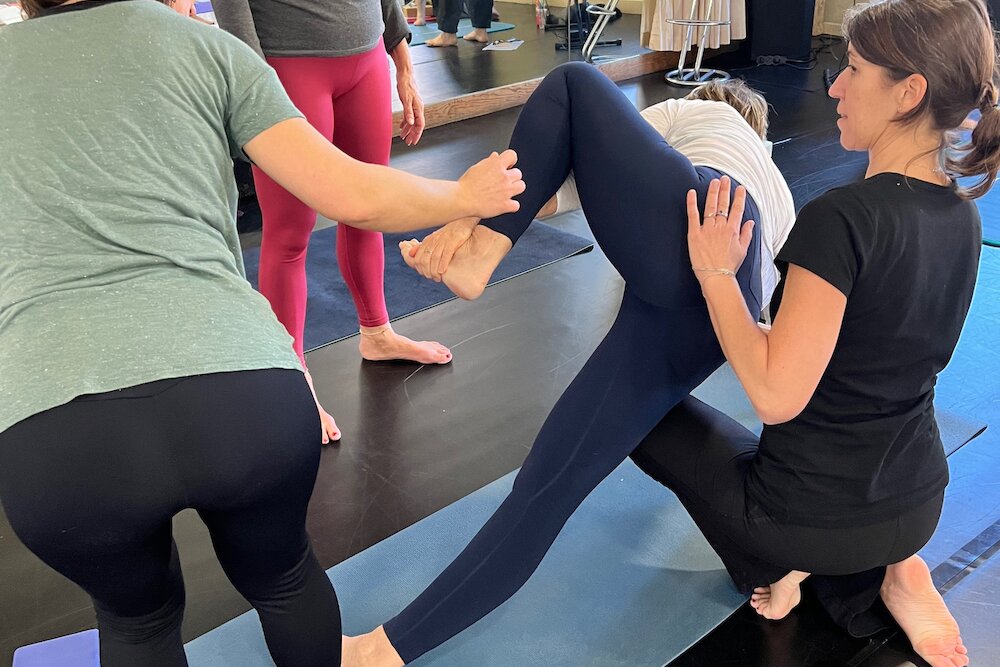
Speaking and listening with the heart… or with the head?
We’ve all experienced those moments in conversation when it becomes clear that the other person isn’t really hearing us. We talk about our feelings and inner experiences, and we’re met with “you have to” or “you should.” We speak from the heart, but we’re answered with the head.
The reverse is just as unsettling: we’re looking for structure, clarity, and concrete organization, but we’re met with questions about our deepest intentions or hidden desires. In both cases, the same feeling emerges: that of being alone, of not finding an ear—or a heart—capable of resonating with our experience.
Relational Exchange, Logistical Exchange
In yoga instruction—as in any relationship—these two levels of communication are both indispensable and profoundly different. One could describe one as relational and the other as logistical or strategic.
Relational exchange addresses subjective experience directly, beyond concepts. In a yoga class, it can take the form of an invitation to be receptive to the breath, allowing the space necessary for the body to fully experience it. The intention is not to explain the breath, but to allow it to open the way to the experience of being alive.
The logistical or strategic exchange, on the other hand, focuses on the “how.” In this same example, it involves explaining how the movement of the diaphragm engages certain areas, or how a specific action can reveal areas of sensitivity.
Feeling… and Making Others Feel
These two levels are not opposed to one another. Neither is more valid nor more noble than the other. Feeling and making others feel go hand in hand. But distinguishing between them is essential, for they point to two coexisting dimensions of reality: immanence and transcendence. A transcendence that emerges only because it is recognized, embodied, and experienced within the immanence of the body and posture.
Yet it is easy to get caught up in the logistics: the “how,” the technique, the precise alignment. Place the foot here, orient the pelvis there… and forget that what matters is not the “how” in and of itself, but the possibility it opens up: that of experiencing oneself as a field of manifestation of life.
For the sensory cannot be reduced to a technique. A yoga practice where technique becomes an end in itself loses sight of the heart of the process: the discovery of our deepest nature.
The Art of Going Back and Forth
Knowing how to say: “Place your foot parallel to the edge of the mat,” then adding:
“And feel how a line of energy flows through your body, from the earth toward the sky. You are this movement.”
Perhaps this is where the truest instruction lies: in this constant back-and-forth between the relational and the logistical, between technique and sensation, between intention and concrete action. A living dialogue, where the mind supports the heart, and where the heart gives meaning to the form.