The Difficulty of Being Someone Else
In the past, I didn’t much like to travel and had a hard time understanding the quest for other places that drove my mother, for example—always on the lookout for new destinations, each more distant, dangerous, and exotic than the last. Because I didn’t like being different, being seen, being identified as “the other”—a tourist—as belonging to a conquering and ignorant Western culture. A culture that presupposes its ideological and material superiority, that imagines the entire planet envies it and longs for the same pseudo-freedom and comfort. I traveled, but I was on the lookout for every little nuance in local customs and traditions, seeking to replicate them as naturally as possible so that I could blend in and disappear.
The Worst-Case Scenario
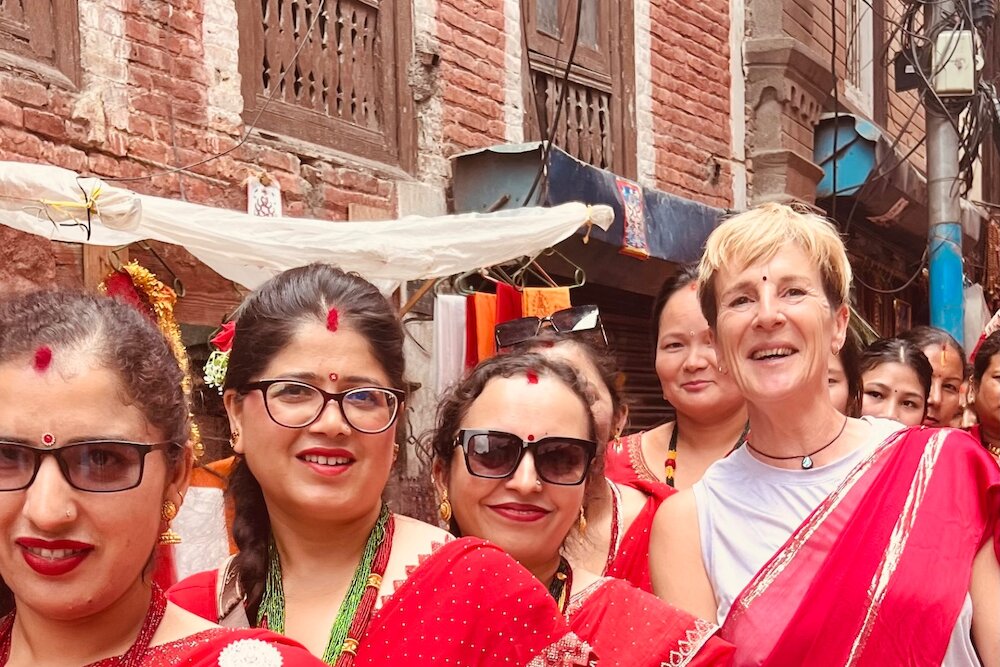
That’s why I surprised even myself with how at ease I felt yesterday during the Teej festival, here in Nepal. For this Hindu ritual, in which women make offerings to Shiva to ensure their husbands’ long life, Saru—the principal of the school where I’ve come to work—dressed me in a sari and placed the traditional tilak on my forehead. My short, blonde head, sticking out several centimeters above the long, black hair adorned with sparkling jewels, was like a beacon in the night. We mingled with the thousands of women, all dressed like me in red saris, and wandered around Pashupatinath, one of the largest Hindu temples in the world. I was the only Westerner, the only blonde; I was visible, exposed, and completely out of place. Just a few years ago, that would have been my worst-case travel scenario.
When the “self” disappears
But something has shifted profoundly in my self-awareness lately. A sense of my own insignificance—that my appearance is not a “self” to be defended or asserted; the dominant and enduring feeling is a kind of transparency of my being. Words, images, glances, and impressions can pass right through me; not that I’m insensitive to them, but they lack permanence and dissolve without leaving almost any trace. Perhaps I’ve shed some of the ego’s armor that acts as a barrier between me and others and is the source of so much suffering at every level of our humanity. In other words, I don’t really care who I am. My identity is far less important than the conscious quality of my experiences.
Cultural appropriation?
Not only was I not bothered by the many stares and heads turning as I walked by, but I felt welcomed and enveloped by all the red, the scent of incense, and the singing and dancing. I also realized that “cultural appropriation” is a concept invented by Westerners and that, paradoxically, it reinforces differences and otherness. Because several women stopped me to thank me or to tell me I was beautiful. I received nothing but smiles and laughter, and I didn’t take any of it as mockery; I simply saw it as an expression of spontaneous joy at seeing a ritual shared or perceived as appreciated.
Rediscovered Freedom
Even my judgments have softened. Admittedly, I saw the weight of religious superstitions and patriarchy, but my opinion on the matter could not be settled once and for all; it, too, became part of the dances and the scents and remained in limbo. Oh, the relief of having no certainties, and of letting oneself live, of letting experiences wash over me! To become transparent but not empty—a transparency that is a space of unconditional openness to everything. To lose a little more of one’s identity in order to rediscover the freedom to be.