Writing
Actually, the only things that really interest me are feelings and openness, and those are what I want to talk about. I’m not interested in compiling information or methods. The means, the technical aspects, the tools, the “how-to”—they bore me. I’m passionate about being. Experience. The experiential.
Voice. Path.
I hear a child speaking to the waitress in English in a commanding tone. I’m surprised by such confidence in such a young voice. I look up and see a woman in her thirties. She’s with a young man, too. I wonder if he, too, is embarrassed by that childish voice. Because it’s definitely embarrassment I feel as I watch her.
Thinking and Feeling
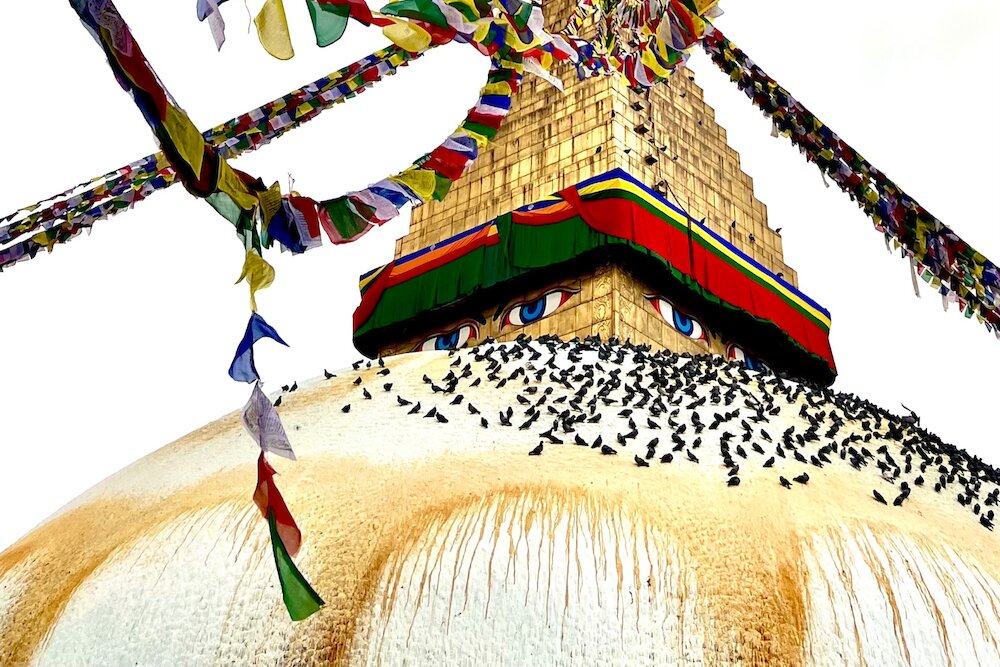
I should go to Bodnath. Today. Because I’m a Buddhist and I can’t miss this. And there’s Shirley, too. Who seems very eager to see me. That’s what I’m thinking.
The pleasure of being alone, of letting myself drift without any real plan. The desire to sleep in the cool, too. Maybe to read and meditate in the darkness of my room. That’s what I feel.
Bodnath
A real eye-opener this morning at Shechen Monastery. First, the garden with its avocado trees, its gentleness, its freshness. Then Shirley took me into the room where there’s that striking statue of Dilgo Khyentse and his rupa. What a presence. The nature of the mind there—direct and uncluttered. We practiced there side by side. Buddha, Dharma, Sangha—all made manifest.
I can see myself going back there, with Ezraa. May we experience this sense of belonging and meaning together.
Tourism
I don’t like being a tourist. I’m a little disappointed that I’m not more at ease, more enthusiastic. And that I can’t say, “I love Kathmandu—it’s my second home.” The truth is, I love the quiet life on the high plateau where I live in France. The rhythm of my days, which is both free and disciplined. The silence that allows me to immerse myself in the sensations of my being and the world.
A subtlety and nuance that are harder to perceive here; they get lost in the surrounding cacophony. They seem frightened and even overwhelmed by the endless rows of plastic goods “Made in China” aimed at tourists. Buying things and bringing them home might be reassuring. It leaves a sort of trace of our visit and objectifies our experience. Whether it’s a Tibetan singing bowl, a mandala, or a fake North Face bag, we’ll justify our purchase by saying we got a good deal. And above all, we’ll be able to say we were there; some will even claim to have “done” Kathmandu. Because it’s much easier to smooth over the rough edges of the experience than to bring back as souvenirs the ugliness, the noise, the discomfort, and the filth that are also part of the journey.
When I hear some Westerners talk to me about the beauty of India or Nepal, I wonder what they’ve actually seen. Or rather, what they’ve ignored. All those lives we ultimately know nothing about—those women who serve me my coffee at breakfast—where do they sleep at night? What do they think of those Western women who spend on a hotel room what they themselves earn in several days or even a week? Perhaps their families even consider them lucky because they speak the few words of English that give them access to these undeniably privileged jobs in Nepalese society. I think that’s what bothers me the most—not being fooled by the exoticism, being fully aware of my privilege as a Western woman, which means that our interactions will never be spontaneous and authentic but will always be guided by an implicit hierarchy. I wish I could be invisible here. So I wouldn’t feel this distance.
I envy the Western Buddhists who feel at home here. Who feel they are “at the source.” I wish I’d finally found the “center,” but my day in Bodnath yesterday—in the heart of Tibetan Buddhism—only reinforced the feeling that my practice, in the end, has no geographical boundaries. Here I see the weight of superstitions, of a religious Buddhism that is certainly also a form of control. And I recognize Mingyur Rinpoche’s incredible subtlety in his ability to navigate these contrasts and to speak to our humanity beyond Buddhism and its forms. Perhaps it’s arrogant of me, but I feel as though I’ve grasped the essence of the teachings—or at least that I’m on the path to a true and profound understanding—and that all the trappings ultimately matter very little. Letting myself be guided by the vision rather than by the means.
Traveling without being a tourist. Perhaps that sums up today’s feeling. Whether in geographical or cultural travel, as well as on the spiritual path.