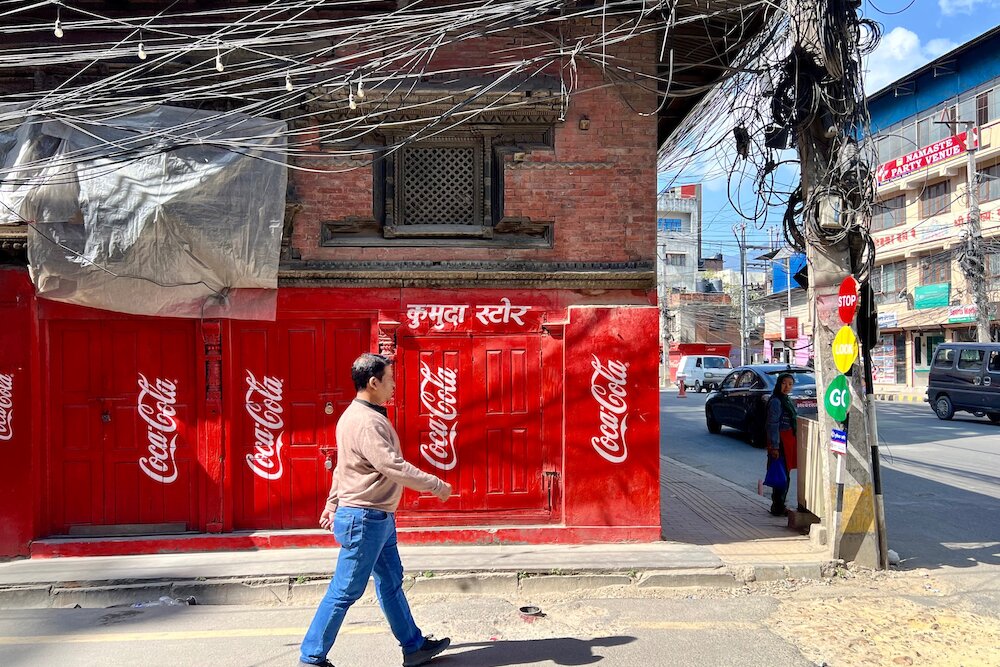
Thamel, a tour of the neighborhood
What amazes me most is how people live their lives. Like that woman I just saw riding on the back of a motorcycle without a helmet. What are her living conditions like? Does she ever find a moment of peace? What are her dreams? Has she ever been to see the distant mountains I spotted from the plane?
I’m going to look for a place to stay over the next few days, trying not to get lost. The large garden whose long walls I saw from the taxi. The Garden of Dreams.
I don’t think I like Thamel, even though it’s certainly fun—this jumble of motorcycles, shops, and people. But there’s just too much of it. Too many things—plastic, smells, colors. And, of course, noise. I’m not looking for the typical tourist spot. I’m looking for something authentic. I saw some tiny little stalls a little further away near the airport, full of colors and women in saris. The people looked like they actually lived in those neighborhoods. Not a single blonde face. Here, the locals just come to work. For the lucky ones, I suppose.
Hotel Manang
In my 4-star hotel, everything is quirky: the light switches, the pictures on the walls, the doors. But it must certainly be opulent for the staff, who earn in a month what I spend in two or three days.
“Namaste” is no longer just a catchphrase meaning “I do yoga and am spiritual”; here, it’s said with a spontaneous smile—even just to hold the door open for you.
Garden of Dreams
Garden of Dreams. A strange little haven of peace. Much smaller than I expected. But “lush”—that’s the word that comes to mind in English. There are plenty of staff at these tourist spots. A natural elegance. A good dozen men and women are watering and cleaning. It’s nice to see this level of care and these people. We’ve lost the habit of it in our highly automated Western world.
I can see how the settlers must have loved these preserved spaces. Money buys you relative peace and cleanliness. Next to me, some English women are chatting; a little further away, a man is reading. That’s what I’d planned to do, but I forgot my glasses, so I’m typing, hoping the spell-checker will fix things as I go.
From my experience this morning, I sense the possibility of a sense of belonging. I project onto my wanderings the same attitude that the hippies had; I imagine, I suppose, another place—and precisely because of its otherness, the possibility of an opening of the self. It’s surprising how geographical distance is also mental or psychological.
In fact, the word “mental” or “mind” tires me. Because it seems to designate something, as if one could pinpoint a specific space for certain movements that make up our identity. This unfortunate Western habit of thinking of ourselves in “parts”—supposedly to help create distance, but thereby leading us to believe in the possibility of control. As if “I” were always external and could make the other “parts” obey. What an illusion. The very one that creates our suffering.
The coffee finally makes my headache go away. I feel a slight surge of intellectual energy. Invigorating. Or is it simply a return to “normal” that reassures me?
I think of Ezraa, my son; sometimes I even have to force myself to remember that we’re living separate lives. He’s over there and I’m here. And in a way, that changes everything. He’s living in a different reality from mine, and I’m giving him back his freedom. These bonds of codependence we’ve created make our relationship infinitely tender, and I’m moved just thinking about them. But they perpetuate dynamics that have served their purpose and can now give way to a new relationship.
Street Scene
Empty rickshaws, hundreds of motorcycles and scooters honking for unknown reasons. Westerners in sandals, with dreadlocks that might once have been blonde, and bodies sometimes entirely covered in tattoos. Couples in shorts, with mountaineering backpacks, who are afraid to cross the street and stand hesitantly at the curb. The sounds of construction everywhere. Small trucks delivering boxes, barriers, and large canvas bags—and honking as they drive off. Always for no apparent reason. Tiny, colorful taxis and big 4x4s with stickers promising adventure. Two tourists unfold a map—I’m actually surprised such a thing exists, given that the streets are a tangled maze of passageways, doorways, detours, and staircases.
Manang Hotel Bar
Two American mountaineers sitting to my left are talking very loudly about their climb. I get the feeling that one of them is trying to impress me (I’m the only one left to impress) with his story about the bad weather that caught them off guard at a high-altitude camp (I didn’t catch which peak, even though that’s the key detail meant to elicit a reaction from me).
They’d seen me earlier with Jeannette and her friend, the sun-scorched Nepalese guide. Both are seasoned Himalayan climbers. Maybe it’s their way of saying, “We’re part of the high-summit club, too.” If only they knew that Island Peak alone is enough to make me dream.
Tihar Festival
Fire. The city is getting ready for the festival. Welcoming the light at the very moment when, in other parts of the world, people are celebrating darkness. Today is Halloween. It doesn’t mean anything here, even though one or two tourist cafés have tried to decorate their entrances with orange balloons—supposed to evoke pumpkins, I suppose.
This morning, the shops were just opening as I walked through Thamel. Garlands of orange flowers—which ones?—are placed along the windows and hang from the balconies. I’m both curious and unwilling to make the effort it would take to wander through the crowded streets after dark to see the spectacle.
Still, the presence of light at this time of year is astonishing. And it reminds us just how much our relationship with the elements is also conditioned. Because here in Nepal, it’s the light of the moon that we welcome rather than the disappearance of the sun’s light. A nod to the possibilities that open up when we simply learn to see the movement of the world and its planets in a different light.