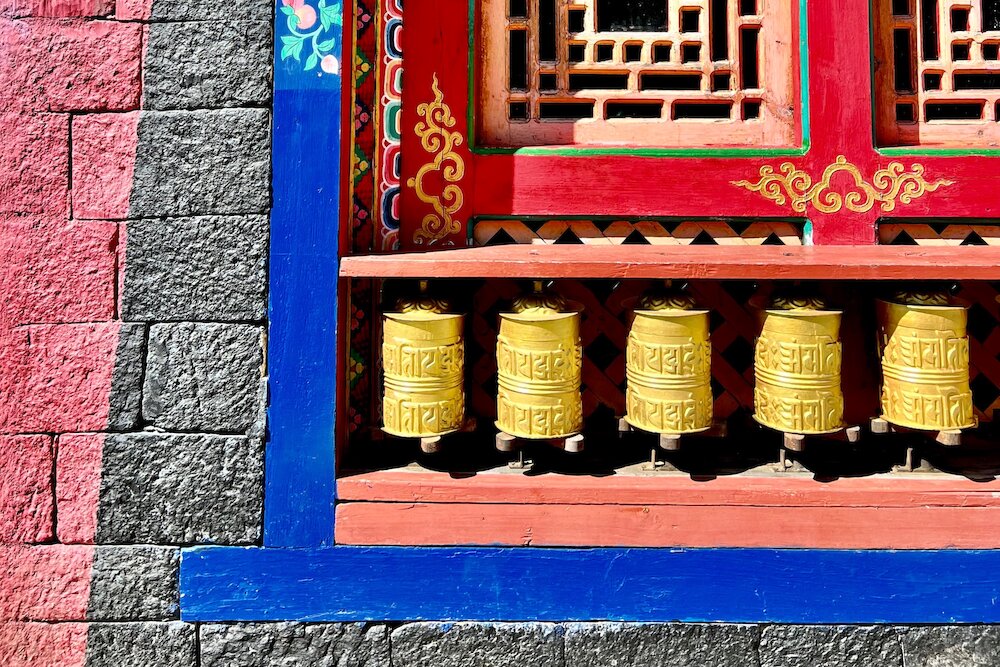
Phakding, the Khumbu region of the Himalayas
A mix of mild annoyance and appreciation.
Much of what I see is tied to tourism: porters laden with large duffel bags bearing the name of a local expedition agency, stalls selling Fanta, Mars bars, and toilet paper, caravans of yaks or mules laden with gas cylinders, tea lodges overflowing with hungry trekkers, and the foreigners themselves—a festival of colorful down jackets and languages. The backdrop to it all is a landscape of steep mountains and deeply incised valleys. There are many pines and firs, including a very elegant variety that looks as if it had been combed and primped to be admired. Moss and ferns, jet-black cliffs, and white torrents with large, striated boulders shaped by the current. There is a very strong presence of the Dharma, in its most visible forms: prayer flags, engraved stones, stupas, prayer wheels, and mani walls. Some stupas are marked with an arrow to remind visitors to offer the right side of their body as a sign of respect. I realize that I know more about the Dharma than many of the people living in these valleys, for whom Buddhism is a set of rituals that structure social life. My approach is conceptual, but not exclusively so. I am moved by places untouched by tourists, such as the Pema Choling Monastery, where we went this morning. The site opened onto the raw expanse of the Himalayas, where most of the snow-capped peaks have not yet been conquered by human ego.
Inside, there was a single monk, reading a sadhana at breakneck speed in a voice that flowed like a river. From time to time, he would ring a small bell, breaking the flow. The gompa itself struck me as beautiful and moving, but also rather crude. The central Buddha statue was chunky, with bulging eyes, a coarse nose, and cheeks that were too wide. A small sign in English listed the benefits of reciting the Vajra Guru mantra: Om ah hum vajra guru siddhi hung. Everything here straddles the line between the elegance of the nature of mind and superstition.
Yesterday we were surprised to make the trip from Kathmandu to Lukla by helicopter. The views were breathtaking—well, no cities, but mountains streaked with tiny terraced fields, all under cultivation, with rounded, copper-colored peaks, some adorned with golden stupas. I found myself longing to be in those sparsely populated areas, and when I think back on it, I associate them with calm and simple wonder. It’s a bit like the atmosphere we discovered while biking through the Sierra Morena in winter with Jojo.
I’m not quite sure what I’m doing here in this group. Not that I don’t like it. Petro is straightforward, with a sharp and candid sense of humor. Louise wants to be liked and is also trying to find her place; she compares our experiences to the motorcycle trips she’s taken around the world. She’s resourceful and has had her share of solo adventures, which she recounts in far too much detail for my mind, which craves simple, direct words. Gladys is playing a role. At 77, I wonder how she dared to come here. Yesterday’s short hike from Lukla to here was very difficult for her. She was out of breath, and her balance is shaky. She wears big shoes and has very thin legs, which gives her a very amusing silhouette. She walks with her arms spread wide like a child trying to find her balance. She’s clearly trying to prove she can do it, and she’s overdoing it for my taste. She climbs on rocks and dances on the suspension bridges. I’m torn between annoyance—she lacks mountain experience, doesn’t listen to what’s going on, interrupts conversations, and makes childish demands—and a certain admiration for the way she asserts her fragility like that. She’s determined to reach Everest Base Camp; I wonder what she’ll be able to appreciate about the journey that will take her there.
I don’t know how to describe Jeannette. She stands out in this setting; she’s very tall and blonde, and she seems nonchalant and tired. Yet she knows a great deal about the culture and the mountains; you can sense her respect and love for the Khumbu. She speaks with a South African accent that strikes me as both distinguished and deeply evocative. I think I could walk in silence with her for hours or even days.
Phunjo is a force of nature. Petite and very strong. She’s bursting with energy and laughs with her eyes. She comes from a tiny village in the Himalayas and is one of the few female Nepalese guides. I’d love to get a glimpse of her life beyond her appearance and her work. This woman, who holds the record for the fastest ascent of Everest—under 15 hours—lost her mother, who died in childbirth, and two of her siblings to chickenpox. She mentioned this when I asked her if there was medical care in her village.
I might be alone. In fact, I stayed tucked away in my sleeping bag this afternoon. I slept and daydreamed. I can hear Gladys’s voice from the other side of the wall as I write these lines—a stream of American words expressing American concerns, those of a woman seeking recognition. And for my part, I find myself thinking, “I didn’t pay for this.”
Deep down, the “I” doesn’t really care because it’s hardly present. Most of the time, I become space, and when I become “me” again, the discomfort of having to assert my existence invites me once more to disappear from myself.