Namche Bazaar, 3,440 m
Encounter
Glimpses of daily life can be seen amid the hordes of trekkers from all over the world on their way to EBC (Everest Base Camp).
Pemba—which means “Saturday”; Nepalese people often name their children after their day of birth—runs the Khumbu Lodge. He is charming, distinguished, and speaks English very well. A close friend of Jeannette and Phunjo, he puts us up in the suite reserved for the Nepalese mountaineering star Nimsdai, now known worldwide thanks to the Netflix documentary chronicling his exploits. I learn from Jeannette that Pemba lost his wife, who died at age 28 during a botched operation in the midst of the pandemic. His grief is palpable; there’s a certain darkness about him that makes him endearing to me, and I feel a kind of human tenderness toward him. He comes over to sit at our table several times. I ask him questions, curious to know what it’s like to live here, in this village perched at 3,500 meters, accessible only on foot—the nearest road is hundreds of kilometers away. He was born here; his parents founded the first lodge. There’s a school—just elementary school—and after that, he had to walk an hour to get to the equivalent of middle school, and the same walk back at the end of the day, sometimes in winter with snow up to his knees. It’s still the same today for the village children. He’s involved in the valley’s development; he explains that a group has formed to bring in more electricity and reduce waste. Everything is complicated—there are many rules imposed by the government, and nothing can be done without corruption.
People speak Tibetan here, mixed with Nepali and sprinkled with a few English words that have found their way into the language. People speak very quickly and laugh a lot.
Women
This morning, as I was making my way down from the plateau above the village along a steep path with uneven steps, I passed a good twenty women of all ages. They were coming back from the market—which was once the gathering point for the entire valley, hence the name “bazaar”—carrying enormous loads on their backs, held in place by a strap resting on their foreheads, just like porters. Where trekkers twist their ankles in their high-tech hiking boots, these women set their plastic flip-flops down with a sure foot, the soles worn down and warped by the weight. I don’t know where they were going; higher up, I didn’t see any dwellings except for a shepherd’s hut and two lodges, including the famous Everest Hotel.
View
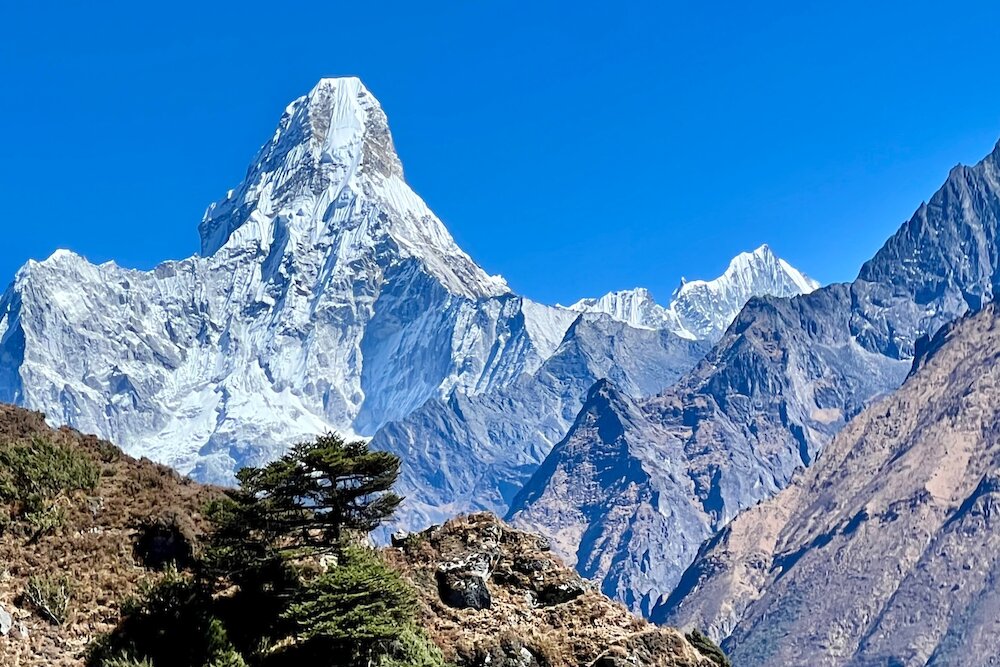
We walked all the way to the Everest Base Hotel as an acclimatization hike; the view was indeed spectacular. Everest on the left, then Lhotse and Nuptse. Further to the right, Ama Dablam. I don’t know where my fascination with this mountain comes from. The name captivated me long before I ever saw it in pictures. Ama Dablam, “mother necklace.” There’s something maternal in the sound of the name—it evokes a goddess but also a mystery. Its shape is perfect, much like the Matterhorn, which ended up on Toblerone bars.
I was alone when I first caught sight of it; I’d arrived on a brown plateau, and near a stupa where Jeannette had asked me to wait, I saw this wall of light rise up on the horizon. I was moved. Touched. Overwhelmed. Ama Dablam. In the flesh, materialized before my eyes.
I told Phunjo about my desire to experience this mountain. She suggested we climb it together as climbing partners rather than as guide and client. I was deeply moved by this offer. And what had started as a joke—“Let’s climb Ama Dablam”—began to take on the feel of a real possibility. A horizon that has no defined line yet, but toward which a momentum is building, a heart is beating.