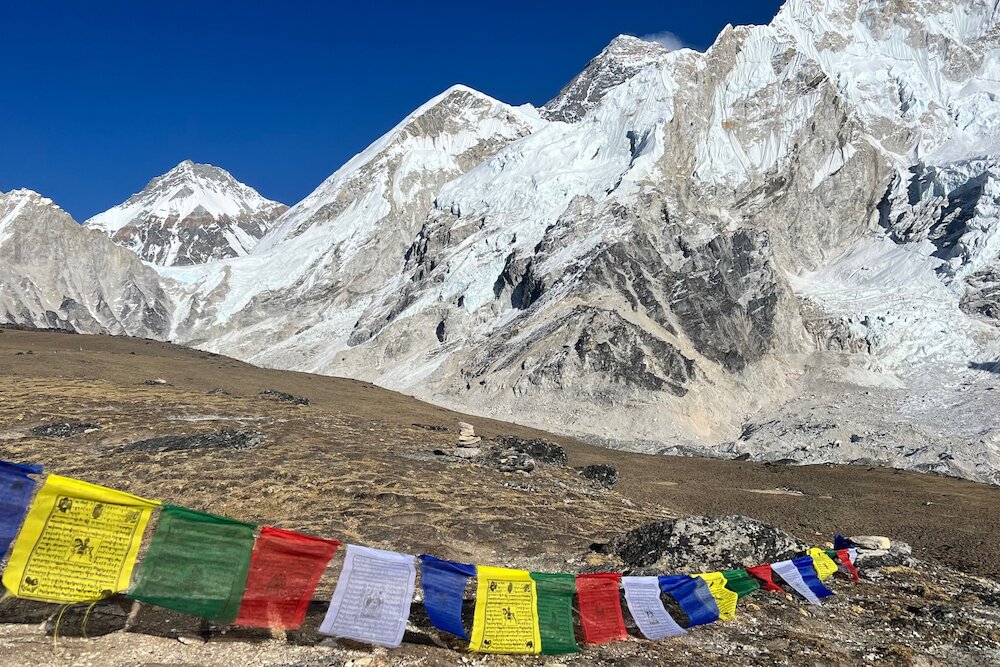
Renjo La, 5,360 m
La. The pass in Tibetan. This place between earth and sky. The transition. The point where the view opens up, where the heart beats very fast, where the long, hard effort is rewarded with the gift of space.
Immense here. Boundless. Phunjo described it to me as “I am not born.” The nature of the unborn mind in Buddhist teachings takes on its full meaning here. A non-intellectual meaning, a feeling that transcends perceptual and elemental categories—pure presence. Not my presence, but presence itself.
At the pass, in this space in between, we hang a prayer flag. It will carry “Om Mani Padme Om” on both sides of this threshold. This mantra protects the mind from all narrowing.
The open. The open is at once vivid blue, heart-red, generous yellow, vibrant green, and white. White is the dominant color—the color of the Buddha’s energy, capable of embracing everything with love and equanimity. Luminous emptiness is right there. And the self dissolves in a sigh of satisfaction—the satisfaction of having finally reached the wholeness longed for since time immemorial.
Gokyo, 4,750 m
Meals
We eat our meals in lodges; we almost always eat the same thing: dahl bat (rice, lentils, and potatoes in curry), with no meat—since it’s carried on the porters’ backs, so you can imagine the quality… I manage to eat—not large quantities—but the appetite that had completely vanished in Kathmandu, as so often happens when I travel, has returned a little. The girls talk a lot about food; they’re dreaming about what they’ll eat when we head back down to more forgiving altitudes where vegetables grow. I don’t really care, and—as is often the case—I feel a bit detached from those concerns.
Gladys
The Gladys saga has taken on absurd proportions. She had to be carried yesterday over the pass and down the descent, which was full of snow and ice—by Jeannette, a porter who stayed behind, and Sanjip, the apprentice guide who’s training with Phunjo. It took them 13 hours—they left at night and arrived at night. She has the nerve to yell at Jeannette, telling her it’s her fault—too many rocks, too much snow… she even insults her. Not a single “thank you.” So this morning, Phunjo gave her an ultimatum: either you’re evacuated by helicopter, or we’ll offer you a trek at a lower altitude. They’re talking right now as I write this. It’s mind-boggling—just because she paid, she thinks the mountain should adapt to her. And if we tell her she doesn’t have the ability or skills for this environment, she calls us racists (anti-Asian—her parents are from China) and accuses us of ageism and discrimination. Jeannette is going to call her daughter today to fill her in on the situation. All of this makes us laugh sometimes, but it creates a pretty lousy atmosphere during meals when she’s there.
Rest day today in Gokyo. The wind is freezing; I was going to take a hike up to a peak at 5,400 meters, but I’m in my sleeping bag and I might just spend most of the day here.
“Gladys” has become a verb: “I’m going to Gladys it.” I’m going to make an insane amount of noise by rummaging through everything in my duffel bag for a good hour.