Lobuche, 5,000 m
I’m feeling a little in need of some comfort. For now, I’m finding it within the confines of my sleeping bag, where I’ve taken refuge for most of the afternoon. The lodges are dirty. I’m a little less so—I took a shower, trying not to move my feet in a filthy stall.
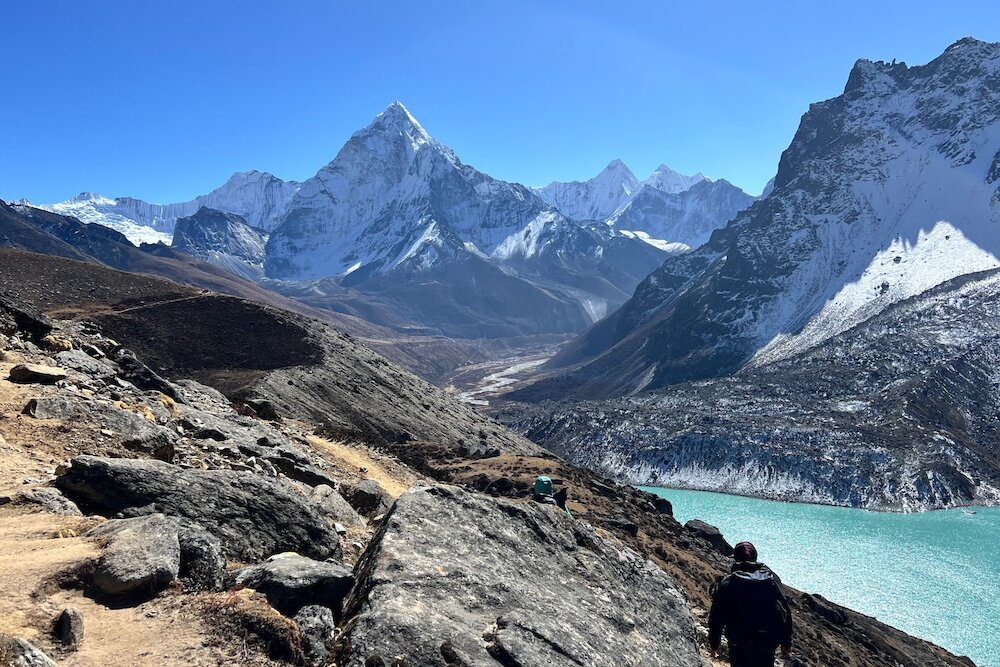
We walked with a pace that was both gentle and brisk along the lateral moraine of the Khumbu Glacier. A breathtaking view of the north face of Ama Dablam, the mountain of my dreams. It’s a story I tell myself—I don’t know if it’s true. But aren’t all dreams made of a vague longing that’s also a little scary?
Jeannette and Phunjo tell me it’s possible. What I love is the idea of having this outrageous goal—one I’d never seriously considered before. What intimidates me most, in the end, is having to learn the technical skills alongside others. I like to forge my own path.
To our right were Nupste and Lhotse, and behind us, Cholatse—the peak that Jeannette dreams of. To our left was Lobuche.
Last night, there was a very noisy group from Quebec with three children, including a very little girl. Blonde with blue eyes, she wasn’t the least bit intimidated by her surroundings. I learned this morning from Phunjo that this little girl’s father had successfully climbed Everest 11 times. I wonder what a mountaineer’s life is like—it must be a bit like that of an astronaut. They see outer space, then return to Earth and its little worries. How do you balance the two?
I’d like a little more comfort—cleanliness, especially—but at the same time, I feel truly alive here. An astronaut of life. The mountains, exploring the world. It’s all here.
Island Peak, 6,183 m
I’m adding this paragraph a month after my return to France, just as I’m posting my journal on this blog. The timeline has become even more blurred—it already was at the time. I remember that the days and places just followed one after another without my needing to remember or plan ahead. I even had to apologize to Jeannette for having to ask again where we were going and what the next stop was. Not that I didn’t care—I was simply letting myself be carried along by the rhythm of our walk and deeply immersing myself in a process with no destination. The pleasure of letting oneself be guided, completely, without restraint, of surrendering to the flow. That’s what stays with me the most, I think, now. The days retain that vitality; they know how to unfold—I just have to let myself be carried along.
Island Peak is, in theory, along with Everest Base Camp, the highlight of the trip. Because it’s the highest, the most difficult, and the most unexpected. In practice, my memory of it is drowned out by the others, and it isn’t necessarily a standout moment. I do, however, remember a strong sense of ease, of precision in my movements, and of confidence in my breath—even when it was short. Above all, I remember the ice walls we climbed using fixed ropes—the shimmering blue, the horizontal striations that I almost wanted to bite into like a mille-feuille.
Reaching the summit brought no sense of catharsis other than the relief of having made it to the top. Not for me, but for Jeannette, who was exhausted and angry at her lack of fitness. I wanted to start the descent before she did; I sensed she was putting it off, and I was right—the return trip was grueling for her and seemed endless to me. Several times I felt like following my impulse and racing down the slope, but I was afraid of upsetting her—she, the guide who was so experienced and yet so exhausted. I remember the bond I shared with our sherpa; we smiled at each other a lot—the only communication possible between us aside from his “don’t worry, chicken curry,” which he kept repeating to Jeannette whenever she worried about the belays on the descent. I felt right at home, capable, and at the same time realized—just as I had during the ascent of Aconcagua—what a privilege it is for a human to be up there so high, amid the ice and the cold.
This climb also reminded me of my own strength—and of the fact that you have to know how to take care of yourself when your fingertips are freezing, your nose is running, your back is weakening under the weight of the pack, and your crampon has slipped out of place. You have to find the energy and the right move to make adjustments, all while continuing to clip the ascender onto the fixed rope and finding a foothold. It takes precision, care, and patience. You have to believe it’s possible, and take care of yourself so you can afford the luxury of forgetting yourself a little and keep moving forward. Play with the “I,” once again.