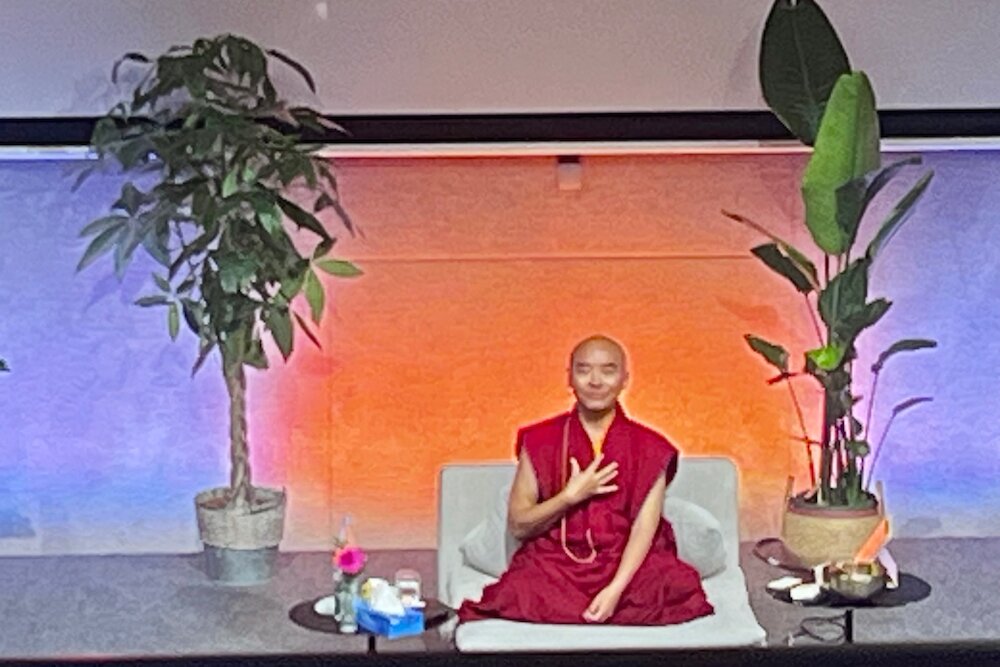
This was my second time attending Mingyur Rinpoche’s “Anytime, Anywhere Meditation” retreat. Here is a summary of some of the key points—ideas that can be helpful both on the meditation cushion and in everyday life.
It happens to us often: we are sitting on our meditation cushion, notice a little tension in the body, and shift position to find greater comfort. From a Buddhist perspective, this small physical movement is an expression of compassion—for what else are we seeking but to avoid suffering?
Mingyur Rinpoche explains that every movement we make—physical, mental, or emotional—is an attempt to seek happiness and avoid suffering.
The same is true of behaviours and emotions we generally consider negative, such as anger, fear, the need for control, or even the judgements we pass on ourselves. Behind each of these reactions lies an attempt—often clumsy—to find happiness and avoid suffering.
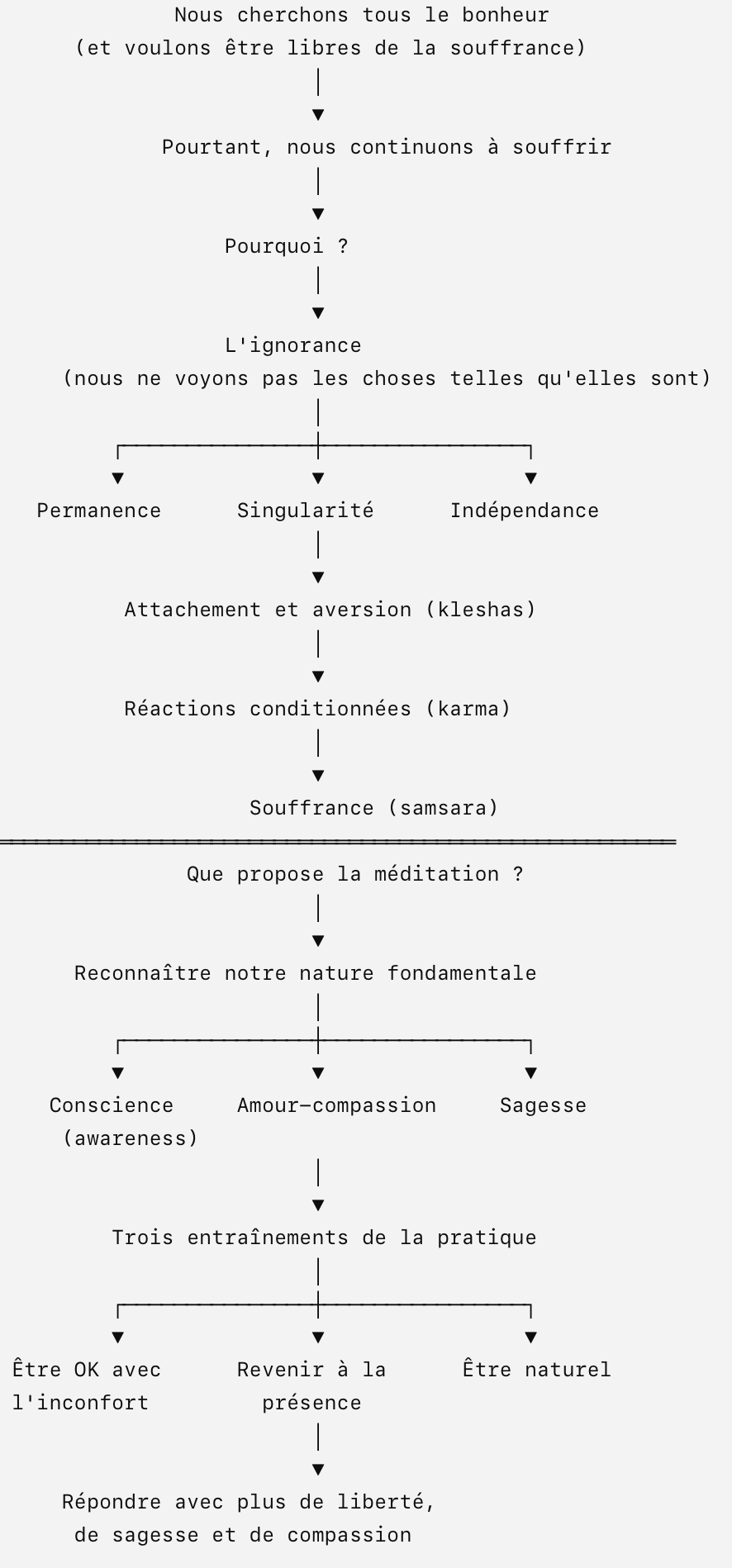
This raises the question: why do these attempts remain unsatisfying?
Because what lies behind them is an impossible object of pursuit—something Buddhism describes in terms of:
-
permanence
-
singularity
-
independence
We believe that things are permanent, when in fact they are constantly changing. We see ourselves as separate and independent beings, when in reality we are caught in a web of interdependence. And we attribute a solidity to our identity that it does not possess.
In other words, we are seeking a reality that does not exist. In Buddhism, this is called ignorance. Ignorance does not mean a lack of knowledge; it refers to a mistaken way of perceiving reality.
From ignorance naturally arise attachment and aversion, which traditional Buddhism describes as poisons, or causes of suffering. We spend our time trying to hold on to what we like and push away what we dislike. As a result, we expend a great deal of energy struggling against things as they are—either trying to keep them or trying to get rid of them.
As we repeat these reactions over and over, they become habits. Buddhism refers to them as karmic imprints: patterns of conditioning that eventually operate on autopilot. And from these conditioned reactions, even more suffering arises. This is the vicious cycle known as samsara.
These habits—also referred to as kleshas—veil our true nature. It is this true nature that Buddhism and meditation invite us to recognise and reconnect with, because it is the true source of lasting happiness.
What are the qualities of our true nature, also known as Buddha-nature?
Our innate nature is aware, full of love and compassion, and wise.
These three qualities—awareness, loving-kindness and compassion, and wisdom—are inseparable:
-
Awareness is the very capacity to experience. It is not awareness of something; it is awareness itself.
-
Wisdom is our ability to recognise and discern.
-
Love and compassion are present in our fundamental aspiration to be happy and free from suffering.
These qualities do not need to be created. They are already present.
Mingyur Rinpoche often uses a very simple gesture to illustrate the three qualities of our true nature: he simply raises his hand.
In the perception of that raised hand, we find all three:
-
the awareness that allows us to see and experience it
-
the wisdom that allows us to recognise, discern, and identify it as a hand
-
the love and compassion that arise from our deepest motivation: by responding to Mingyur Rinpoche’s invitation to see his raised hand, we are seeking relief from dissatisfaction and a path towards happiness
Another useful image, one that Mingyur Rinpoche often uses in his teachings, is that of light and flame.
A flame illuminates—and, in a sense, illuminates itself. This serves as a metaphor for consciousness, which does not need to be illuminated by anything other than itself. This is known as self-luminosity.
The flame also illuminates the objects around it. In Buddhism, this corresponds to awareness of something and is sometimes referred to as “other-luminosity”.
Here, the hand is like an object illuminated by consciousness. The light is not in the object, but in consciousness. What the hand reveals is not merely a hand; it is the consciousness that illuminates it.
The role of meditation is therefore one of recognition—first and foremost, recognition of our capacity for awareness and full presence.
Mingyur Rinpoche reminds us that this capacity is so close and so simple that it is very easy to overlook our deepest nature. At the same time, awareness is always present—twenty-four hours a day, even while we sleep. We simply do not recognise it.
We lose ourselves in objects—what Buddhism calls duality. These objects may be things we perceive directly, but they may also be our reactions to the external environment or to our internal states. They become objects of consciousness, and we give them enormous power over us.
So how can we lift the veils—the kleshas—that prevent us from seeing that what we seek has always been present?
In this retreat, which is open to everyone, Mingyur Rinpoche offers three fresh ways of understanding traditional Buddhist teachings that I find particularly insightful.
The first is learning to be comfortable with discomfort—to be okay with not being okay. Simply ceasing to struggle against every unpleasant experience already begins to loosen attachment and aversion.
The second is presence. Returning, again and again, to immediate experience allows us to gradually step out of autopilot.
The third is being natural. When we stop reacting solely out of habit, wisdom can begin to guide our responses to situations.
And all of this begins with the formal practice of meditation.
We are sitting on our cushion. Very quickly, something begins to bother us, or a tension arises. Can we stay with the changing intensity of our experience without reacting to it in a conditioned, automatic way?
The point is not to remain motionless in order to appear stoic, but to allow ourselves to experience whatever arises without reacting to it as we usually would. Not to torture ourselves, but to discover that we have the capacity to be present, directly and naturally, with any kind of physical, emotional, or mental intensity.
Of course, sitting meditation is only a small laboratory. What we practise there can then extend into the rest of our daily lives.
In each of our movements and interactions, the same conditioned habits will appear. Can we remain present to the intensity of a conversation without reacting in our usual way? Can we experience physical discomfort without immediately resorting to complaint or avoidance?
The aim is not to torture ourselves, but to open ourselves to new possibilities of being. In this way, every moment of the day becomes an opportunity to recognise our habits, return to presence, and make room for an open awareness that allows for wise and compassionate responses to each situation as it unfolds.
From this perspective, our difficulties are no longer obstacles to the practice. They become precisely the places where the practice can unfold.
This is only a small excerpt and summary of the experience of this retreat. I can only encourage you to participate with curiosity.
The teachings do not necessarily strike us in the moment. Often, they resonate later—when discomfort arises.