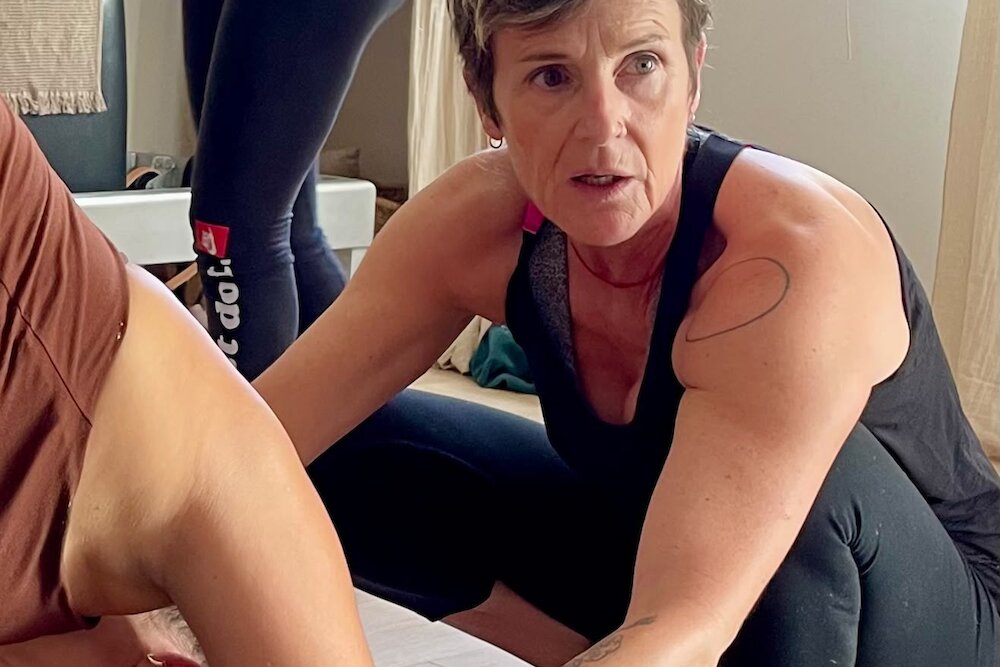
The same intuition, still alive.
I have been teaching yoga for twenty-six years and training yoga teachers for thirteen. I have devoted a large part of my life to practicing, studying, exploring, and sharing this path. Over time, some of my understandings have deepened, new insights have emerged, and my way of living and teaching yoga has gradually evolved.
Yet I have never strayed from my original intuition: within the relationship between body and mind lies the possibility of living differently, and yoga offers a path through which to explore that possibility.
After all these years, my enthusiasm remains undiminished. I still believe that at the heart of human experience, within the interdependent relationships between body, breath, and mind, lies a genuine potential for transformation.
This is undoubtedly why I continue to practice and teach with so much curiosity and enthusiasm.
Yoga, Far Beyond the Postures
I find it reductive to regard yoga as merely a physical discipline or a technique devoted exclusively to well-being. For me, yoga is first and foremost a tradition of the spirit, in the original sense of the Latin word spiritus. It is a path of inquiry into our conscious experience, an invitation to explore the nature of mind, to observe our conditioning, the way we perceive the world, and how we participate in it.
The word “awakening” can sometimes arouse suspicion or give rise to all sorts of projections. Yet it remains the word that most accurately describes the opening that yoga invites us to experience: a profound transformation in how we perceive, understand, and inhabit our existence.
I make no claim to guide anyone toward awakening. I am still on the path myself, with my doubts, my uncertainties, and my contradictions. What I do aspire to share, however, is a yoga that opens up new perspectives, inviting us to look differently at our human experience and the possibilities it holds.
It is a demanding aspiration, one that I choose to pursue today with even greater conviction than when I first began.
What Is the Relationship Between Body and Mind?
One question has accompanied my entire journey with postural yoga, from my first tentative steps in the late 1990s to the present day: what is the relationship between the postures—the asanas—and the inner dimension that yogic traditions describe as spiritual?
Why do we practice postures? What can our embodied experience teach us about how we inhabit the world? And how can this practice contribute to a transformation that extends far beyond the physical abilities we develop on the mat?
This question led me to explore yoga as a vast field of inquiry, one capable of embracing the life of the body and the life of the mind within a single movement.
I studied its history, philosophy, and many traditions, quickly discovering that there is no single yoga, but rather a constellation of approaches, sometimes converging, sometimes diverging.
For a long time, I could not find a fully satisfying answer to the question of the body–mind relationship. In the classical yoga of Patanjali, for example, the body appears primarily as something to be transcended in order to attain samadhi. The body serves as a necessary support, but is not itself the privileged ground of knowledge.
It was in the tantric traditions that I found my first answers.
Bringing an Inner Dimension to Physical Experience
When I began studying Anusara Yoga in 2008, I discovered, through the teachings of John Friend, a coherent attempt to connect physical postures with the tantric philosophy of Kashmir Shaivism.
For the first time, I encountered a clear articulation of the relationship between body and mind: an approach in which the biomechanics of the postures become the foundation for an inner experience that opens onto deeper qualities of awareness.
The expression John Friend used to describe this intention still resonates with me today: the role of the posture is to “physicalize” the intrinsic qualities of the mind.
This idea has profoundly shaped my teaching. It gives meaning to precision in movement, to the attention we bring to our foundations, and to the way we engage with a posture. Technique is not an end in itself. It becomes a means of exploring qualities that are not merely physical: stability, receptivity, trust, the ability to engage without becoming rigid, to make an effort without losing sensitivity.
The legacy of Anusara Yoga remains one of the foundations of my teaching today. Over the years, however, I have felt the need to reformulate some of its principles and enrich them through other fields of study.
A Yoga Informed by Buddhism and Contemplative Science
After teaching Anusara in its original form, I gradually became aware of a tension between my practice of the Buddhist Dharma and the philosophical and Hindu religious context from which Anusara emerged.
My Buddhist studies, which began around the same time as my exploration of postural yoga, have profoundly shaped my understanding. In Buddhism, I found a path grounded in experience rather than dogma, in the exploration of what it means to be human rather than in reference to the divine, in immanence rather than transcendence.
This orientation also resonated with my academic and philosophical research. Contemplative psychology, pragmatism, contemplative neuroscience, and movement science have gradually enriched my understanding of the relationships between body and mind.
I have never considered these different fields to be areas of knowledge that should remain separate. They offer complementary perspectives on human experience, without necessarily speaking the same language or pursuing exactly the same goals.
Today, I continue to study, to bring these perspectives into dialogue, and to experiment. My yoga has evolved, as has my understanding of the body, movement, breathing, and meditation.
In my physical practice, I now approach traditional yoga postures with a more interdisciplinary perspective, integrating elements from mobility training, floorwork, Animal Flow, and breathwork. On a psycho-spiritual level, I also draw more explicitly on Vajrayana Buddhism, whose contribution I consider essential to developing a practice that can illuminate our entire lives, rather than simply the time we spend on the mat.
What interests me is not preserving a particular form of yoga, but continuing to explore what these practices allow us to understand and transform within our experience.
Feel, Integrate, Open: The Heart of My Teaching
Out of these different influences, the approach I teach today has gradually emerged. It is built around three fundamental principles: feel, integrate, and open.
Feel, because all self-knowledge begins with encountering our experience as it is. The body is not simply something we seek to master or improve. Above all, it is a place of perception, exploration, and knowledge—a place of experience and experimentation. Learning to feel means cultivating a more refined awareness of what is happening within us, without trying to correct or control it.
Integrate, because our experience is so often fragmented. We separate body and mind, effort and sensitivity, thought and feeling. Yoga invites us to explore their interdependence, to rediscover a sense of coherence between our intentions, our actions, and the way we inhabit the world.
Open, finally, because this knowledge only has meaning for me if it allows us to broaden our perspective and loosen the grip of our conditioning. It is not about becoming a better version of ourselves according to some predetermined ideal, but about recognizing the possibilities contained within our human experience, beyond the habits and assumptions that limit it.
These three principles run through every dimension of my practice and teaching: physical, pedagogical, personal, and spiritual. Together, they form the heart of what I wish to share.
Why I Continue
After twenty-six years of teaching, I am no less curious than when I first began. Quite the opposite: the further I go in my practice and studies, the more I realize how much there is still to discover.
I do not claim to know everything about yoga. But what I do know, I have experienced across the different dimensions of my life. The meeting of physical practice, inner inquiry, and wisdom traditions has profoundly transformed my way of being in the world. It is this experience that continues to inspire my desire to teach.
I continue to teach because I am convinced that yoga can help us develop a more conscious relationship between body and mind, allowing them to work together in the service of a freer, more creative, and more vibrant life.
I also continue because I do not see teaching as the transmission of knowledge acquired once and for all. Teaching requires me to question what I think I know, to refine my intuitions, and to remain attentive to the uniqueness of each person and the diversity of human experience.
My contribution is simple: to bring those who sense that another way of living is possible into contact with paths of knowledge that can broaden their perspective, soften their conditioning, and support the emergence of a freer and more conscious existence.
All of this rests on a deeply held conviction: our human potential is simply waiting to be recognized and cultivated.
It is this conviction that continues to inspire me today, just as it did twenty-six years ago. With more experience, certainly, but also with the same curiosity and enthusiasm for this endless exploration of the relationships between body and mind.